
Painting a stucco house in Phoenix this fall: what to check before the painters come (and 2026 costs)
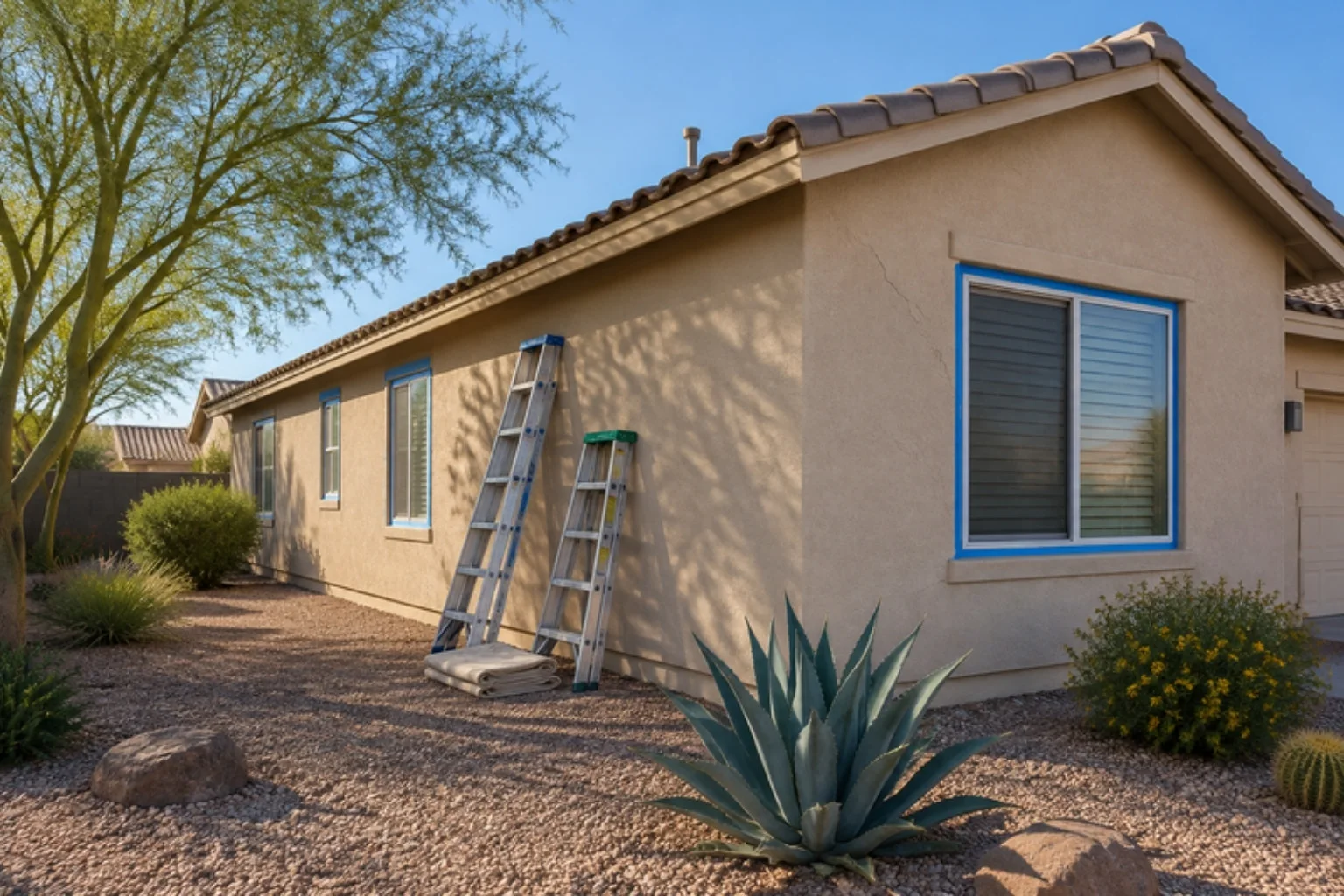
Late fall is when Phoenix's exterior painting season really opens: the city's average last 100°F day is Oct. 5, and normal November highs are about 77°F. Repainting a typical 2,100 sq ft one-story stucco home in the Phoenix area costs about $3,100–$5,200 in Homestimo's 2026 pricing, of which labor is about $2,600–$4,500. Before painters start, walk around the house and check five things: cracks, chalky or faded walls, the trim and fascia, what is not in the house price (block walls), and the painter's Arizona ROC license.
In most of the country, fall is the last chance to paint outside before it gets too cold. Phoenix works the other way around: summer is too hot to paint well, and the season opens once the triple-digit days are over. If your stucco has faded, chalked or cracked through another summer, this is the time to get quotes. Here is what to look at on your own walls first, so the quotes you get cover the right work, and what a Phoenix-area stucco repaint costs in 2026.
Why late fall is Phoenix's painting window
Sherwin-Williams warns that in extreme heat (over 100°F) paint can dry before it has a chance to bond to the surface, which can lead to peeling later, and it advises against painting in direct summer sun. Phoenix averages 111 days a year at or above 100°F. By late October those days are usually over, and the next few months are mild:
| Period | Normal high | Normal low |
|---|---|---|
| Oct. 5 | average last 100°F day | |
| November | 76.5°F | 53.7°F |
| December | 66.2°F | 45.3°F |
Source: NWS Phoenix, extreme temperatures (1991–2020 normals; the latest 100°F day on record was Oct. 27, 2016) and NWS Phoenix monthly climate summaries for November and December at Sky Harbor.
Two things still matter in winter. Sherwin-Williams says many latex paints need temperatures above 60°F to cure properly (some newer products are rated down to 35°F), and that the temperature should stay above the dew point for at least 48 hours after painting. Phoenix nights in December can drop into the 40s, so ask which product the painter will use and whether they plan to stop early enough in the day for the paint to set before evening. After a rare heavy rain, the same guide suggests waiting at least a day, because masonry soaks up moisture.
Walk around your stucco before you ask for quotes
You don't need to do any prep yourself. The point of the walk-around is to know what your house needs, so you can tell whether each quote includes it. Take photos as you go; they help when you compare quotes or upload one to Quote Compare.
1. Cracks: hairline or wider?
Thin hairline cracks are common on stucco and are usually handled in normal prep. Wider cracks, cracks that have come back after an earlier repaint, or spots where the stucco sounds hollow or has broken off are a different job: stucco repair, which is usually priced separately. Mark them in your photos and ask each painter how they will handle them and whether that is in the price, a per-crack charge or an allowance.
2. Chalky or faded walls
Rub your palm across the wall that gets the most afternoon sun (usually west or south). If it comes away white or colored with powder, the old paint is chalking. Faded, chalky walls need a thorough wash and sometimes a primer or conditioner so the new paint sticks. Ask whether that is included, and compare the sun side with the shade side: the difference shows how hard the sun has been on the old coat.
3. Fascia, eaves and wood trim
Look up at the fascia boards and the wood around windows, doors and the garage. Peeling, split or soft wood is common after years of sun. Painting over it does not fix it: soft or rotted wood has to be replaced first, and that is not part of a normal repaint price, including the ranges below.
4. What is not part of the house
Many Phoenix-area homes have block yard walls, courtyard walls, gates, pergolas or a detached casita. Our ranges below cover the house itself: stucco walls, soffits and fascia, window trim, entry doors and one garage door. If you want the yard walls painted to match, ask for them as a separate line on the quote so you can see what they add.
5. Color, HOA and age of the home
- HOA: if your home is in an HOA, check your community's rules for exterior colors before you book. Some require approval of the color before work starts.
- Big color change: going from a light desert tan to a dark color (or back) usually needs an extra coat; in our pricing it adds roughly 5–12%.
- Built before 1978: paid painting work that disturbs old paint in a pre-1978 home falls under the EPA's lead-safe (RRP) rules. Ask whether the firm is EPA lead-safe certified.
What a stucco repaint costs in the Phoenix area (2026)
Homestimo prices Maricopa County homes from county records. These are typical one- and two-story stucco homes in good condition, painter supplies the paint. Labor is the same job if you buy the paint yourself; the rest is paint and materials.
One-story stucco homes
| Home | Total | Labor |
|---|---|---|
| 1,400 sf | $2,500–4,100 | $2,000–3,600 |
| 1,700 sf | $2,800–4,600 | $2,300–4,000 |
| 2,100 sf | $3,100–5,200 | $2,600–4,500 |
| 2,500 sf | $3,400–5,700 | $2,800–5,000 |
Two-story stucco homes
| Home | Total | Labor |
|---|---|---|
| 2,500 sf | $5,100–9,000 | $4,100–8,000 |
| 3,200 sf | $5,800–10,300 | $4,700–9,100 |
sf = living area in square feet. Paint and materials for a 2,100 sf one-story home come to about $500–$700. Ladders and scaffolding for a second story are why two-story homes cost much more.
How the condition of your walls moves the price
For the same 2,100 sq ft one-story home:
| Walls | Total |
|---|---|
| Good | $3,100–5,200 |
| Some wear | $3,400–6,100 |
| Heavy wear | $3,900–7,400 |
| New color | $3,200–5,800 |
Some wear = some peeling or chalking to scrape and spot-prime. Heavy wear = widespread peeling. New color = good walls, big color change. Stucco crack repair beyond normal caulking is not included.
Phoenix-area exterior repaints, mostly sprayed stucco, come in well below what painter wages alone would suggest, so our model applies a Phoenix adjustment based on local prices homeowners report. The local labor adjustment is still an estimate, which is why the ranges are wide. Enter your address below for a range built on your own home's size from county records.
Before you sign: license and quote checks
- Arizona ROC license. In Arizona, a contractor's license from the Registrar of Contractors is generally required for any job totaling $1,000 or more in labor and materials, or one that needs a building permit, and anyone working under the handyman exemption has to say "not a licensed contractor" in their ads (Arizona Commerce Authority). Every repaint in the tables above is over that line. The residential painting license class is R-34, Painting and Wall Covering (Ariz. Admin. Code R4-9-103). Look up the license number on the ROC website before you pay a deposit.
- Product and coats. The quote should name the product line and say two coats (or what the coats are). Standard exterior acrylic and thicker elastomeric coatings are priced differently, so make sure the quotes you compare use the same kind.
- Cracks and wood. How are cracks handled, and what does a fascia board replacement cost if one is found soft?
- What is excluded. Yard walls, gates, patio covers and the casita, each as its own line if you want them.
- Schedule. Ask when they expect to start and how they plan the days around sun and cool evenings.
Our guide to checking a rushed painting quote covers deposits and written scope in more detail.
Free. We measure your home from public county records; no name or phone number needed.
Frequently asked questions
When is the best time to paint a house exterior in Phoenix?
From late October through spring, once the 100°F days are over. Phoenix's average last 100°F day is Oct. 5, and normal highs are about 77°F in November and 66°F in December (NWS Phoenix). Paint makers warn against painting in extreme heat and direct summer sun.
How much does it cost to paint a stucco house in Phoenix?
In Homestimo's 2026 pricing, a typical 2,100 sq ft one-story stucco home in the Phoenix area costs about $3,100–$5,200 to repaint in good condition, with labor about $2,600–$4,500. Two-story homes of 2,500–3,200 sq ft run about $5,100–$10,300. These are planning ranges, not quotes.
Do painters in Arizona need a license?
Generally yes, for any job totaling $1,000 or more in labor and materials or one that needs a permit. The residential painting classification with the Arizona Registrar of Contractors is R-34. Check the license number on the ROC website before paying a deposit.
Should stucco cracks be fixed before painting?
Thin hairline cracks are usually handled as part of normal prep. Wider cracks, cracks that keep coming back or loose stucco are a repair job that is usually priced separately, so ask each painter how they handle them and whether it is in the price.
Weather figures are from the National Weather Service Phoenix office (1991–2020 normals at Phoenix Sky Harbor; extreme temperature records page), checked October 2026. Paint temperature and dew guidance is from Sherwin-Williams' exterior product application FAQ. Arizona licensing rules are from the Arizona Commerce Authority handyman page and Ariz. Admin. Code R4-9-103. Prices are 2026 planning ranges for Maricopa County homes from Homestimo's pricing model (stucco all around, good condition unless noted, one garage door, pressure wash, caulking and two coats; wood rot, stucco repair and yard walls not included), not contractor quotes. The Phoenix exterior adjustment is based on local prices homeowners report and is still an estimate; your price depends on your home, your contractor and the exact scope.